
Choosing the right Pilates reformer for your fitness studio is a high-stakes strategic decision that requires triangulating three critical vectors: your specific teaching methodology (Classical vs. Contemporary), the biomechanical needs of your target demographic (rehab vs. athletic performance), and the long-term economic reality of Total Cost of Ownership (TCO). It is not merely a purchase of furniture, but an investment in the primary delivery vehicle of your service. The “right” machine is one that minimizes operational downtime through industrial-grade engineering while maximizing client retention through superior haptic feedback—specifically, how the carriage glides and how the springs communicate tension to the body. If you prioritize initial sticker price over these factors, you risk inflating your long-term costs through frequent maintenance and a degraded client experience; if you over-specialize without considering your business model, you risk alienating the general population.
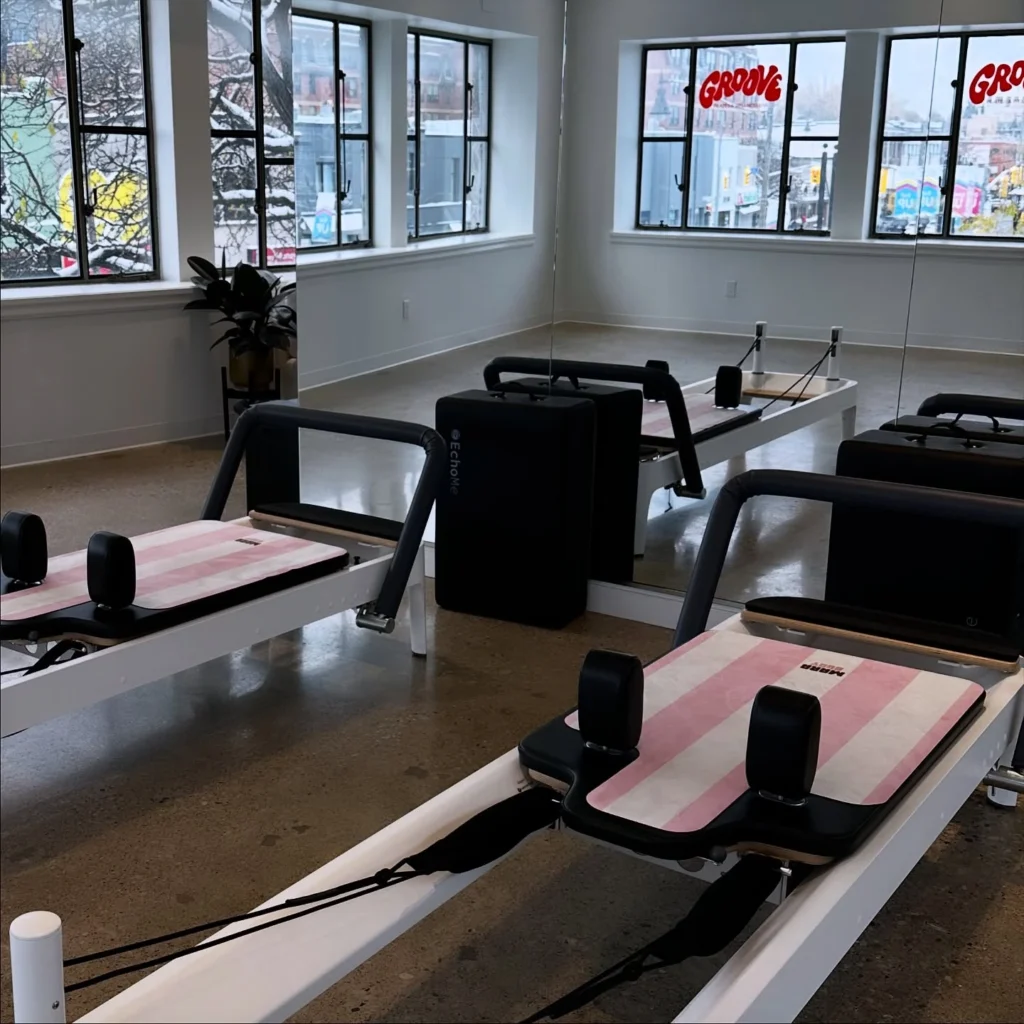
1. Why is the Reformer the Heartbeat of Your Studio’s Profitability?
Why does the specific engineering of a metal or wood frame dictate your bottom line? Because in a boutique fitness environment, the reformer is the tangible interface of your brand promise. When a client pays a premium per class, they are not just paying for instruction; they are paying for the відчувати of the movement.
From a business perspective, the reformer represents your studio’s capacity for revenue generation. A machine that is out of order due to a snapped rope or a jammed wheel is a “dead seat”—a direct leak in your revenue stream. Therefore, the profitability of a reformer is measured not by its purchase price, but by its utilization rate і lifecycle durability.
The Psychology of “Perceived Value”
Clients may not understand the physics of spring tension, but they possess high proprioceptive sensitivity. They can feel the difference between a carriage that “floats” on precision bearings and one that “drags” on friction pads.
- Безшумна робота: High-end commercial reformers (like those from Merrithew, Balanced Body, or Basi) use custom-extruded rails and polyurethane wheels to ensure silence. A noisy machine breaks the “flow” state of a class, shattering the mind-body connection that clients seek.
- Tactile Rigidity: A reformer that wobbles or flexes under load signals “instability” to the user’s nervous system, triggering a fear response rather than confidence. An ultra-rigid frame (whether maple, oak, or powder-coated aluminum) allows the client to trust the equipment fully, leading to deeper engagement and faster physical results.
Return on Investment (ROI) vs. Sunk Costs
A generic or “light commercial” reformer might save you $1,500 upfront. However, if that machine requires upholstery replacement every 12 months ($300/machine) and spring replacements twice as often ($150/set), your savings evaporate within two years. A true commercial-grade reformer is designed to last 10–15 years with minimal intervention. When calculating ROI, factor in the resale value. Premium brands hold 60-70% of their value even after five years, turning your equipment into a liquid asset rather than a sunk cost.
2. What Technical Specifications Matter Most for Longevity?
What specifically should you look for when inspecting a spec sheet? You must look past the aesthetic finish and scrutinize the mechanical stress points. A studio reformer undergoes thousands of cycles of compression and tension daily.
The Rail System: The Highway of Movement
The rails are the most critical wear component.
- C-Channel Aluminum: Used in modern machines (like the Allegro 2 or SPX Max), these are virtually indestructible and resistant to pitting. They offer a “slicker” ride that is ideal for fast-paced, athletic contemporary flows.
- Solid Wood Tracks: Found in classical designs. They offer a softer, more organic feel but require more maintenance (waxing) to prevent friction buildup.
- The “Bump” Test: Run your hand along the rail. Any imperfection, joint, or seam will be felt as a “bump” by the client during every plié. The best studio reformers have seamless, single-piece rails.
Upholstery: The First Point of Failure
Studio upholstery is not just vinyl; it is a barrier against sweat, friction, and cleaning chemicals.
- Boltaflex® or Naugahyde®: Look for these industry-standard materials. They are treated with antibacterial finishes and are rated for over 500,000 “double rubs” (a measure of abrasion resistance).
- Stitching: Avoid “French seams” (where the fabric is folded over and stitched) on the carriage surface, as these collect sweat and bacteria. Look for “seamless” or bottom-stapled corners that are easy to wipe down.
The Gear Bar and Footbar Mechanics
- Locking Mechanisms: In a group setting, safety is paramount. A footbar that collapses if kicked or pulled incorrectly is a liability lawsuit waiting to happen. Look for positive-locking footbars that click audibly into place and require a two-hand release to move.
- Adjustability Speed: If your instructors have to spend 45 seconds adjusting gear bars between classes, you are losing billable time. Modern “no-gear” systems or single-step adjustments allow for rapid transitions, essential for 50-minute class blocks with 10-minute turnovers.
3. Who Are Your Clients and How Does That Dictate Your Choice?
ВООЗ is lying on the carriage? The anthropometrics (body measurements) of your clientele must dictate the physical dimensions of the machine. One size does not fit all in a commercial setting.
The “Vertical” Client: The Height Factor
- Studio Height (14-16 inches): This is the standard. It is versatile for most athletic populations.
- Rehab Height (24 inches+): If your studio targets seniors, post-rehab patients, or pregnant women, a higher “Clinical” reformer is non-negotiable. Getting down to the floor is a barrier for these populations. A higher carriage allows them to sit and lie down with dignity and safety.
- Athletic Sizing: Professional athletes (NBA/NFL players) or populations averaging over 6 feet tall cannot use a standard 38-inch carriage comfortably. Their range of motion (ROM) will be truncated. You may need “Stretch” versions (which add 6 inches to the frame) or machines with extended tracks.
The Weight Capacity Question
Standard home reformers are rated for 250-300 lbs. In a studio, you need a Safety Factor of 4. This means the machine should technically be able to withstand 1,000+ lbs of static load to safely handle a 350 lb moving client performing dynamic jumps. Stick to machines rated for at least 350-400 lbs of dynamic user weight.
Proprioceptive Feedback Preferences
- The Purist: If your clients are dancers or Pilates traditionalists, they expect the “drag” and feedback of leather straps and four distinct springs.
- The Fitness Enthusiast: If your client base is coming from CrossFit or HIIT, they often prefer the mechanical precision of rope systems with silent pulleys and heavier spring loads.
4. How Do Spring Dynamics and Resistance Mechanics Affect User Experience?
Як does the spring actually work? This is the “Deep Mind” physics of Pilates. The spring is the soul of the machine; it is what creates the unique eccentric loading phase that builds long, lean muscle.
Linear vs. Progressive Resistance
- Hooke’s Law: Ideally, a spring should follow Hooke’s Law (F=kx), where resistance increases linearly as the spring stretches.
- Hysteresis: This is the energy lost as heat when the spring expands and contracts. Low-quality springs have high hysteresis, meaning they feel “sluggish” on the return. High-quality music-wire springs (like those from Balanced Body or Merrithew) have low hysteresis, providing a “snappy” return that assists the client’s rhythm and neuromuscular timing.
Spring Coding and Tension Curves
- The “Classical” 4: Classical reformers use 4 springs of equal tension. The challenge comes from the body’s positioning and leverage, not the spring change. This requires a higher skill level from the client to control.
- The “Contemporary” 5 or 6: Modern studios usually prefer 5-spring systems with color-coding (e.g., 3 Red/Heavy, 1 Blue/Medium, 1 Yellow/Light). This allows for “micro-loading.” You can fine-tune resistance for a 100 lb client versus a 250 lb client much more effectively.
- The “Dead Spot”: Cheap springs often have a “dead spot” at the beginning of the pull where there is no tension. This causes a jarring “clunk” when the tension finally engages. Commercial springs are pre-loaded to ensure immediate engagement the millisecond the carriage moves.
Ropes vs. Leather Straps
- Leather: Used in classical studios. It stretches slightly over time, adding a unique, organic “give” that purists love. However, it requires adjustment holes and buckles, which can be slow to change.
- Synthetic Ropes: Zero stretch. This provides precise, immediate feedback. Modern “riser” systems allow you to adjust the angle of pull, which can modify the muscle focus (e.g., higher risers recruit more hamstrings; lower risers recruit more quads).
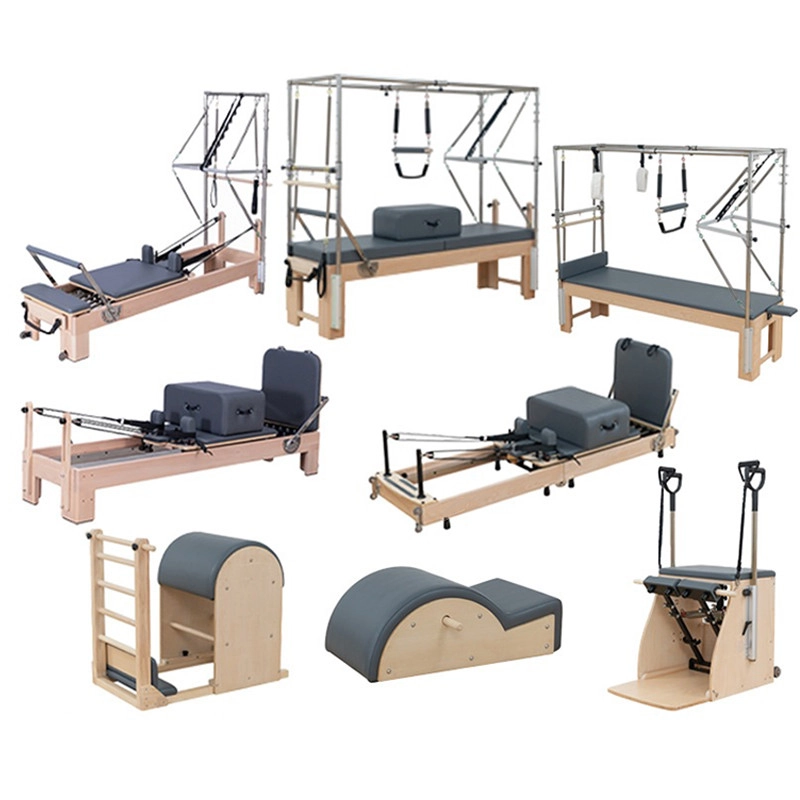
5. Where Does Studio Layout Impact Your Reformer Selection?
Where will these machines live? Real estate is often the second highest expense after payroll. Your reformer choice can effectively “subsidize” your rent by optimizing space efficiency.
The Stackability Factor
If your studio is a hybrid space (offering Yoga or Mat Pilates in the same room), stackability is your most important feature.
- Machines like the Merrithew SPX Max або Balanced Body Allegro can be stacked 5-10 high.
- Warning: Stacking heavy steel reformers is a two-person job and a liability risk for back injuries. If you plan to stack daily, ensure you buy models with “stand-up” wheels and hydraulic assist, or choose lightweight aluminum frames.
The “Flow” Footprint
You need more than just the dimensions of the machine (usually ~8ft x 2.5ft). You need a functional envelope.
- Side Clearance: You need 2 feet between machines for an instructor to walk and correct form.
- End Clearance: You need 1-2 feet at the back for tower exercises or leg extensions.
- Visual Sightlines: Lower profile reformers (14 inches) make a room look bigger and allow the instructor to see the entire class’s form at a glance. High-leg reformers can create visual clutter in a small room.
Vertical Frames and Towers
Do you plan to offer “Tower” classes?
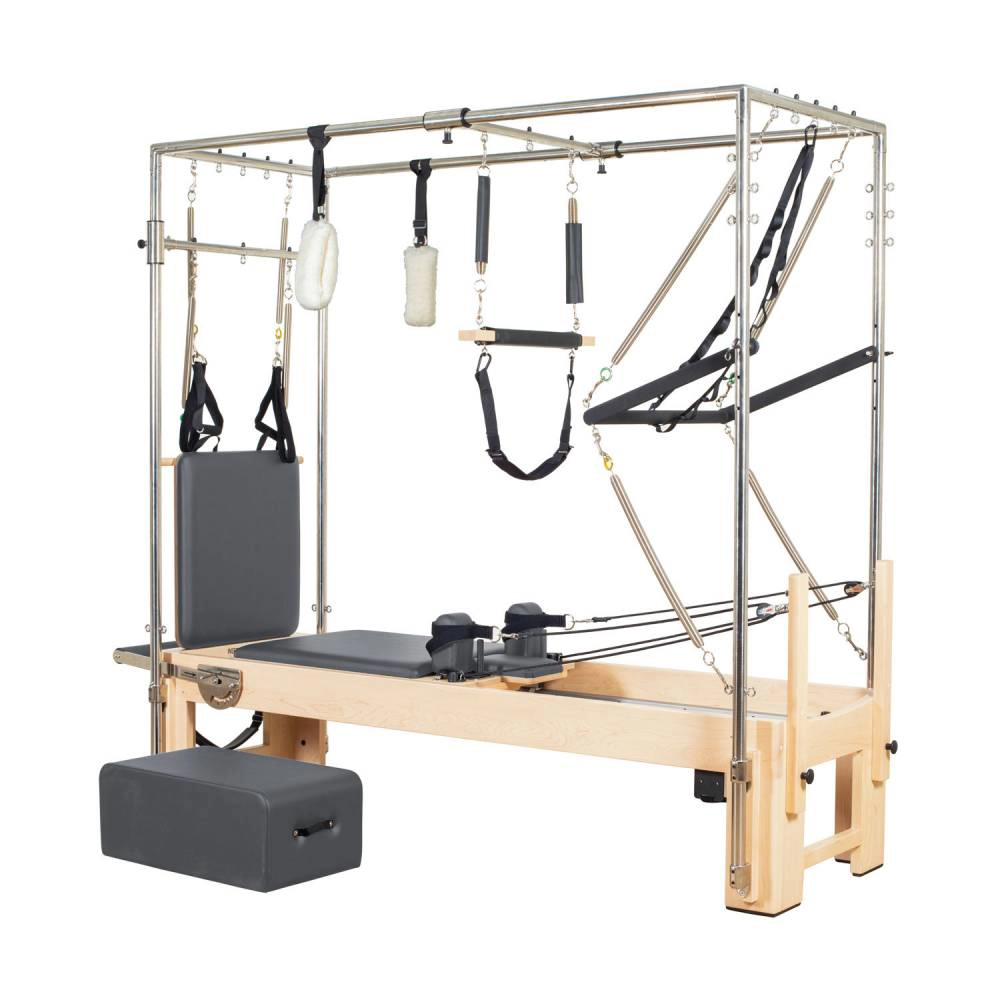
- Integrated Units: Buying a reformer with a tower attached (a “combo” unit) saves floor space compared to having separate Wall Units and Reformers.
- Retrofit Ready: If you can’t afford towers now, buy reformers that are “pre-drilled” for towers. This allows you to upgrade your fleet later without selling your existing machines.
6. When Should You Prioritize Classic vs. Contemporary Designs?
When does the teaching philosophy override the hardware specs? The “Classic vs. Contemporary” debate is the schism of the Pilates world, and your equipment declares your allegiance.
The Classical Studio (Contrology)
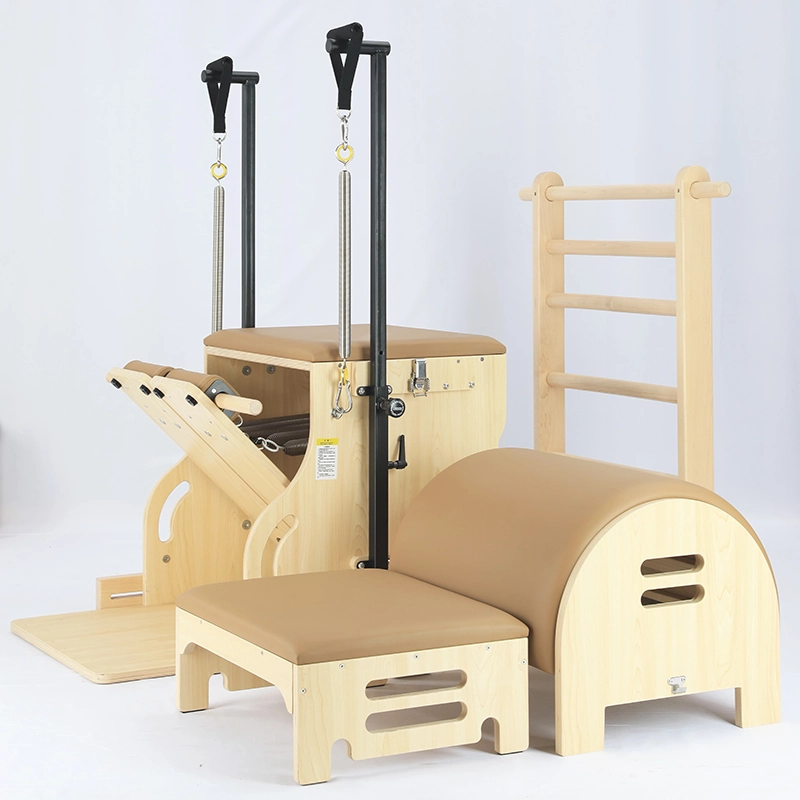
If your studio teaches the work of Joseph Pilates exactly as written, you need a Classical Reformer (like the Contrology line or Gratz).
- Основні характеристики: 4 uniform springs, leather straps, wooden frame, lower gear bar, footbar with limited adjustability.
- The “Feel”: The carriage is often not padded as softly; the focus is on feedback, not comfort. The wheels may deliberately have more friction to force the user to “work” the machine.
- Client Expectation: Clients seeking classical training are often purists. They will notice if you put them on a modern machine with “bells and whistles” and may view it as “inauthentic.”
The Contemporary/Athletic Studio
If your classes involve music, rapid transitions, and fusion elements (cardio, weights), you need a Contemporary Reformer.
- Основні характеристики: Adjustable gear bars, 5-6 varied springs, comfortable padding, wide footbars, jumpboards.
- The “Feel”: Smooth, gliding, adjustable. Designed for flow and variety.
- Універсальність: These machines can accommodate a 6’5″ football player in the morning and an 80-year-old with a hip replacement in the afternoon. The adjustability allows you to modify the mechanics to fit the body, rather than forcing the body to fit the machine.
7. How Much Should You Budget for Maintenance and Total Cost of Ownership?
How much is the “hidden price tag”? A $4,000 reformer might actually cost you $6,000 over 5 years if you ignore maintenance.
The Maintenance Ledger
- Springs: Must be replaced every 2 years (commercial use). Budget $600-$800 every 2 years for a studio of 10 reformers.
- Wheels: Polyurethane wheels wear down and develop flat spots if the tracks aren’t cleaned. Budget for a wheel replacement kit every 3-5 years ($100/machine).
- Ropes/Straps: Replace annually or bi-annually for safety and hygiene.
Shipping and Installation
Commercial reformers are heavy (150lbs+).
- Freight: Shipping can add $200-$400 per machine.
- White Glove: Do not underestimate the labor of unboxing and assembling 10 reformers. Paying for “White Glove” installation ensures the machines are leveled and calibrated by pros. If a machine isn’t level, the carriage will drift, ruining the experience.
Warranty Nuances
Read the fine print.
- Frame Warranty: Should be Lifetime.
- Parts Warranty: Usually 2-5 years.
- Оббивка: Usually only 90 days.
- Commercial vs. Professional: Ensure the warranty explicitly covers “Commercial/Studio” use. Using a “Home” reformer in a studio voids the warranty immediately.
Висновок
The “right” Pilates reformer is the one that sits at the intersection of your business model and your biomechanical philosophy. If you are a high-volume, athletic studio, prioritize the durability and adjustability of a contemporary aluminum machine like the Balanced Body Allegro 2 або Merrithew SPX Max. If you are a boutique classical studio, the wooden aesthetic and specific tension of a Contrology або Грац reproduction is essential to your brand identity.
Remember, your reformers are your employees. They work every single class, without breaks. Treat the selection process with the same rigor you would use to hire a lead instructor. Invest in machines that offer the lowest friction—both for your clients’ bodies and for your business operations.
Часті запитання
1. Is it better to buy wood or aluminum reformers for a commercial studio?
Wood (Maple/Oak): Offers superior aesthetics, warmth, and sound absorption. It tends to be heavier and more stable but is susceptible to humidity changes and scratches. It aligns best with boutique, high-end, or classical studios.
Aluminum: Is lighter, easier to stack, and virtually maintenance-free regarding the frame finish. It has a more “clinical” or “gym-like” look but is often more durable against dings and cleaning chemicals. Choose aluminum for high-traffic, hybrid, or hot Pilates studios.
2. How often do I really need to replace reformer springs?
For a commercial studio running 3-5 classes per day, you should inspect springs monthly for “gapping” (when the coils don’t close tight) and replace them every 24 months regardless of visual appearance. Springs lose their tension curve over time (hysteresis), making the workout easier and less effective without the client realizing it. Snapped springs are a major safety hazard; preemptive replacement is mandatory.
3. Can I mix and match reformer brands in my studio?
It is highly not recommended. Different brands use different spring tensions (e.g., a “Red” spring on a Balanced Body is not identical to a “Red” spring on a Merrithew). Mixing brands confuses clients and makes it impossible for instructors to cue resistance uniformly (“Everyone put on one red spring” won’t work). Uniformity creates a cohesive, professional class experience.
 English (United States)
  English (Canada)
  English (Australia)
  English (New Zealand)
  English (UK)
  Arabic
  Bulgarian
  Czech
Czech  Danish
  Greek
Greek  Spanish
  Ukrainian
  Turkish
  Thai
Thai  Swedish
  Serbian
  Slovenian
  Slovak
  Russian
  Romanian
  Portuguese (Portugal)
  Portuguese (Brazil)
  Dutch
Dutch  Estonian
  Finnish
  French
  Hindi
Hindi  Croatian
  Indonesian
  Icelandic
  Italian
  Japanese
  Georgian
  German
  Lithuanian
  Polish
  Korean
  Uzbek
Uzbek  Hungarian
  Malay
Malay