
Reformer Pilates is one of the most effective cross-training methods available for runners, acting as a crucial bridge between injury prevention and peak performance. By focusing on deep core stability, correcting muscular imbalances, and enhancing joint mobility, Reformer Pilates addresses the specific physical tolls that running takes on the body. It allows runners to isolate and repair overworked muscles while activating neglected stabilizers, resulting in a stride that is more efficient, powerful, and sustainable. Whether you are training for a marathon or enjoying a casual weekend jog, integrating Reformer Pilates can significantly reduce injury risk and improve your running economy.
1. Why Is Reformer Pilates Considered the Ultimate Cross-Training for Runners?
Running is often described as a high-impact, linear activity. You move in one direction—forward—using the sagittal plane of motion. While this is excellent for cardiovascular health, it can lead to a host of biomechanical issues if not counterbalanced. Reformer Pilates provides that counterbalance.
The Problem with Repetitive Impact
Every time a runner’s foot strikes the pavement, the body absorbs impact forces equivalent to up to seven times their body weight. Over the course of a 5k, 10k, or marathon, this adds up to a staggering amount of load on the joints, specifically the ankles, knees, hips, and lower back.
Without a strong structural foundation, this impact is not distributed evenly. It hammers the path of least resistance, leading to wear and tear. Reformer Pilates strengthens the body’s suspension system. By improving the integrity of the connective tissues and strengthening the muscles around the joints, the Riformatore teaches the body to absorb and disperse these forces more effectively, acting as an internal shock absorber.
Unlocking Biomechanical Efficiency
Why do some runners look like they are gliding while others look like they are fighting the ground? The answer is often efficiency. A runner with a weak core or tight hips leaks energy with every step.
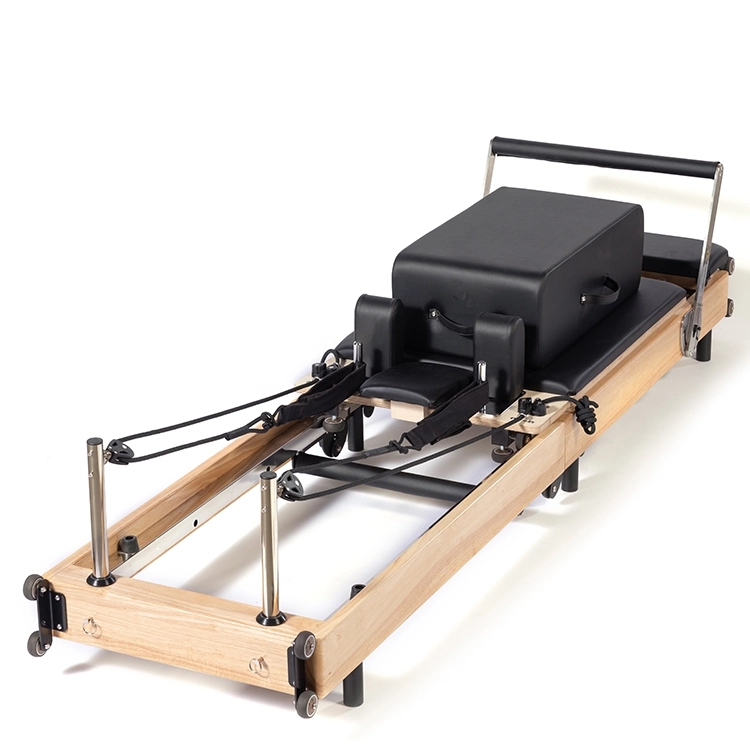
Reformer Pilates focuses on control. The moving carriage and spring resistance provide immediate feedback on your movement patterns. If you are favoring one side or wobbling in your pelvis, the machine will let you know. This cultivates a heightened sense of proprioception (body awareness). When you transfer this awareness to the road, you run with better alignment, meaning less energy is wasted stabilizing a wobbly torso, and more energy is directed into propelling you forward.
2. What Specific Muscular Imbalances Does the Reformer Address?
Running is inherently repetitive, and repetition breeds imbalance. Certain muscles become dominant and tight (overworked), while opposing muscles become weak and dormant (underused). Reformer Pilates is the great equalizer.
The “Desk Job” Runner
A significant portion of the amateur running community works in sedentary office jobs. They sit for 8 to 10 hours a day, which causes the hip flexors (psoas and iliacus) to shorten and tighten. Physiologically, when the hip flexors are tight, the opposing muscle group—the glutes—struggles to fire correctly. This is a phenomenon known as “reciprocal inhibition.”
When a desk-bound runner hits the pavement, their glutes are essentially “asleep.” This forces the hamstrings and lower back to compensate and do the work the glutes should be doing. This is a primary recipe for lower back pain and hamstring strains. Reformer Pilates classes for runners specifically target this issue by stretching the hip flexors (through exercises like Eve’s Lunge) and aggressively activating the glutes, restoring the natural firing order of the muscles.
The Quad vs. Hamstring Battle
Runners tend to be quad-dominant. The Reformer is exceptional at targeting the posterior chain (the back of the body).
- Eccentric Strengthening: Most running injuries happen during the deceleration phase of a stride. The springs on the Reformer allow for eccentric strengthening—working the muscle as it lengthens. This is particularly vital for hamstrings, making them resilient against tears during the swing phase of running.
- Glute Medius Activation: Weak outer hips (glute medius) cause the knees to cave inward (valgus collapse) during a run. This is the leading cause of “Runner’s Knee” and IT Band syndrome. Reformer exercises like “Side-Lying Leg Series” isolate this small but mighty muscle, ensuring the knees track safely over the toes.
3. How Does a Stronger Core Translate to Faster Race Times?
When runners hear “core,” they often think of six-pack abs. In Pilates, the core (or “Powerhouse”) includes the abdominals, the lower back, the pelvic floor, and the hips. A stable core is the platform from which all power is generated.
Plugging Energy Leaks
Imagine a cannon fired from a canoe versus a cannon fired from a concrete platform. The cannon on the canoe loses power because the base is unstable. The cannon on concrete utilizes 100% of the explosive force.
Your legs are the cannons; your core is the platform. If your pelvis rocks side-to-side or tilts excessively while running, you are the canoe. You are losing propulsion power. Reformer Pilates is dedicated to pelvic stability. By strengthening the deep transverse abdominis, you create a rigid cylinder of support for your torso. This ensures that the force generated by your legs propels you forward, not sideways, resulting in faster times with the same perceived effort.
Endurance and Posture
We have all seen the “Marathon Slump.” In the final miles of a long race, a runner’s form often disintegrates—shoulders roll forward, the head drops, and the back rounds. This collapses the chest, restricting lung capacity precisely when oxygen is needed most.
Reformer Pilates emphasizes axial elongation and postural endurance. You train your postural muscles to hold your spine tall even under fatigue. By maintaining an upright posture late in a run, you maintain optimal breathing mechanics and running efficiency, preventing the late-race slowdown.
4. Who Is This Workout Suitable For?
One of the greatest misconceptions is that you need to be flexible or have a dance background to do Pilates. For runners, who are notoriously inflexible, the Reformer is actually the perfect environment.
From Weekend Warriors to Ultra-Marathoners
Whether you are training for your first 5K or your tenth Ultra Marathon, the biomechanics of running remain the same, and therefore the needs remain the same.
- The Novice: For beginners, the body is not yet adapted to the impact. Reformer Pilates builds the requisite tendon and ligament strength to handle the new load, preventing “too much, too soon” injuries like shin splints.
- The Veteran: For seasoned runners, the focus shifts to longevity. Years of pounding pavement can wear down joints. The low-impact nature of the Reformer allows veterans to maintain muscle mass and range of motion without adding more impact stress to their weekly volume.
Accessibility and Modification
Reformer Pilates is highly customizable. If you have tight hamstrings (a runner’s trademark), the straps can be adjusted, and knees can be bent. Unlike a yoga class where you might feel pressure to contort into a shape, the Riformatore meets you where you are. The spring system supports the weight of your limbs, allowing you to move through a greater range of motion safely than you could on a mat. It is an inclusive practice that requires no prior experience.
5. When Should Runners Incorporate Reformer Pilates to Prevent Injuries?
Timing is everything. Many runners wait until they are injured to step into a Pilates studio. While Reformer Pilates is an incredible rehabilitation tool, its true magic lies in prehabilitation.
The “Prehab” Approach
Physiotherapy clinics are filled with runners suffering from preventable conditions: Runner’s Knee (Patellofemoral Pain Syndrome), Iliotibial Band (ITB) Syndrome, Plantar Fasciitis, and Achilles Tendonitis.
These injuries rarely occur due to a single traumatic event; they are overuse injuries caused by poor mechanics repeated thousands of times. By incorporating Reformer Pilates early in a training cycle, you correct the mechanics before the mileage ramps up.
For example, ITB syndrome is often caused by a weak glute medius causing the hip to drop. By strengthening the glute medius on the Reformer before marathon training peaks, you protect the IT band from ever becoming inflamed. The class serves as a diagnostic tool, highlighting tight or weak areas so you can address them before they become pain points.
Active Recovery Days
Running involves concentric muscle contractions (shortening) and high impact. Reformer Pilates involves eccentric contractions (lengthening) and zero impact. This makes it the perfect activity for recovery days. It flushes blood through the muscles to aid repair without adding structural stress. Instead of sitting on the couch on a rest day, which can cause muscles to stiffen, a gentle Reformer flow maintains mobility and aids in the removal of metabolic waste products.
6. Where Does the Focus on “Feet” Fit into the Running Equation?
Runners obsess over shoes, but they often neglect the feet inside them. The foot is the first point of contact with the ground, initiating the kinetic chain.
Footwork on the Footbar
A standard Reformer class almost always begins with “Footwork.” You lie on your back and press against the footbar with toes, arches, and heels.
This strengthens the intrinsic muscles of the feet and ankles, which are often weak in runners who rely on highly cushioned shoes. Stronger feet mean better shock absorption and a more stable landing.
Furthermore, Reformer work emphasizes ankle flexibility. Limited ankle dorsiflexion (the ability to pull toes toward the shin) is a major contributor to knee issues and Achilles tendonitis. The spring resistance allows runners to stretch the calves and Achilles safely and deeply, restoring the range of motion necessary for a healthy stride.
7. The Runner’s Reformer Toolkit
If you attend a Reformer Pilates class specifically designed for runners, you can expect a routine tailored to the demands of the sport. Here are four key exercises that transform running performance.
1. The Scooter (Glute Activation)
The Move: Standing on the floor with one foot against the shoulder rest of the carriage. You hinge forward slightly and kick the carriage back with one leg while the standing leg stays stable in a squat.
Why Runners Need It: This mimics the running stride. It teaches the body to dissociate the hips—one leg extending while the other stabilizes. It fires the glutes intensely and challenges the balance of the standing leg, correcting hip instability.
2. Feet in Straps (Hamstring & Hip Mobility)
The Move: Lying on your back with feet in the loop straps. You lower and lift legs, or open them into circles.
Why Runners Need It: This is arguably a runner’s favorite move. The support of the springs allows for a deep, safe stretch of the hamstrings and adductors (inner thighs) without straining the back. It also flushes the legs with fluid, feeling like a massage while you work.
3. Eve’s Lunge (Hip Flexor Release)
The Move: One foot on the floor, one knee on the carriage. As you push the carriage back, you sink into a deep lunge.
Why Runners Need It: It directly counteracts the tightness caused by running and sitting. By opening the hip flexors, you allow for more hip extension. More hip extension means a longer stride length without overstriding, leading to faster paces.
4. Side-Lying Leg Series (Lateral Stability)
The Move: Lying on your side, strap on the top foot. You lift, lower, and circle the leg against resistance.
Why Runners Need It: Running is forward motion, but stability comes from the side. This exercises the Glute Medius. A strong Glute Medius prevents the hip drop (Trendelenburg gait) that causes knee pain.
8. The Mental Game – Breath and Control
Running is as much a mental game as a physical one, especially in endurance events. Reformer Pilates trains the mind alongside the muscles.
Diaphragmatic Breathing
Pilates utilizes lateral thoracic breathing—expanding the ribcage 3-dimensionally. Runners often fall into the trap of shallow, chest breathing when they get tired, which limits oxygen intake and increases anxiety/heart rate.
By practicing controlled breathing on the Reformer—coordinating the breath with the hardest part of the movement—runners learn to control their respiratory rate under stress. This skill is directly transferable to the final kilometers of a race. When the body screams “stop,” the Pilates-trained runner knows how to use breath to calm the nervous system and persevere.
Tolerance for Discomfort
The “burn” in a slow, controlled Pilates hold is intense. It requires mental fortitude to keep the carriage still when the muscles are shaking. This builds mental resilience. Learning to stay calm and maintain form while in physical discomfort is the exact psychological skill needed to push through the “wall” in a marathon.
Domande frequenti
How often should a runner do Reformer Pilates?
For most recreational runners, two sessions per week is the sweet spot. This frequency is enough to build strength and correct imbalances without causing excessive fatigue that might interfere with your running schedule. If you are in the off-season or recovering from an injury, you might increase this to three times a week. Even once a week provides benefits in terms of mobility and stretching, though strength gains will be slower.
Should I do Pilates before or after my run?
Ideally, Reformer Pilates should be done on a separate day or after your run, not immediately before.
If you do a heavy core and glute workout right before a long run, your stabilizing muscles may be pre-fatigued, which could actually lead to sloppy form and increased injury risk during the run.
If you must do them on the same day:
- Run first: If the run is your priority (interval training or long run).
- Pilates first: Only if the run is a very easy, short recovery jog.
Will Reformer Pilates replace my running cardio?
No. While “Jumpboard” classes on the Reformer can raise the heart rate, standard Reformer Pilates is a strength and conditioning workout, not a cardiovascular endurance workout. It is anaerobic, whereas running is aerobic.
Think of Reformer Pilates as the servicing for your car (the chassis, alignment, and suspension), while running is the driving. You need the servicing to keep driving safely and efficiently, but the servicing doesn’t replace the miles on the road. They are complementary, not interchangeable.
The Verdict: Essential, Not Optional
Is Reformer Pilates good for runners? It is arguably the single best investment a runner can make outside of good shoes. By addressing the root causes of common running injuries—weak glutes, tight hips, and poor core stability—it keeps you on the road and out of the doctor’s office.
Beyond injury prevention, it unlocks potential. A runner with a balanced body, an efficient stride, and a strong core is a faster runner. Whether you want to shave minutes off your personal best or simply want to run pain-free for years to come, the Reformer provides the toolkit to make it happen. Step off the treadmill and onto the carriage; your body will thank you for every mile thereafter.
 English (United States)
  English (Canada)
  English (Australia)
  English (New Zealand)
  English (UK)
  Arabic
  Bulgarian
  Czech
Czech  Danish
  Greek
Greek  Spanish
  Ukrainian
  Turkish
  Thai
Thai  Swedish
  Serbian
  Slovenian
  Slovak
  Russian
  Romanian
  Portuguese (Portugal)
  Portuguese (Brazil)
  Norwegian
  Dutch
Dutch  Estonian
  Finnish
  French
  Hindi
Hindi  Croatian
  Indonesian
  Icelandic
  Italian
  Japanese
  Georgian
  German
  Lithuanian
  Polish
  Korean
  Uzbek
Uzbek  Hungarian
  Malay
Malay